

Results of Public Monitoring of School Libraries Discussed
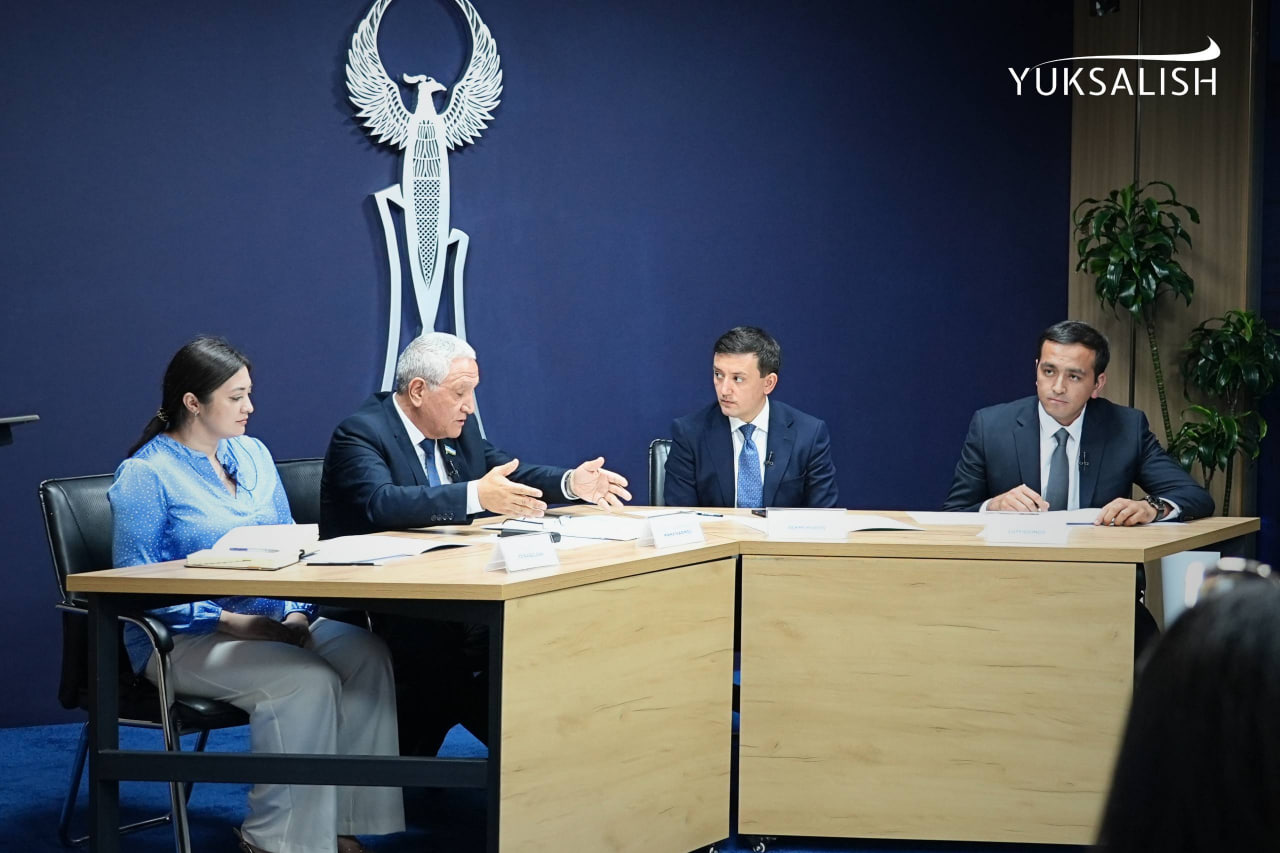
On 21 August, as part of Sustainable Development Goals Month, the Committee of the Senate of the Oliy Majlis of the Republic of Uzbekistan on Science, Education and Healthcare, in cooperation with the “Yuksalish” Movement, presented the results of public monitoring conducted to assess the current state of general education school libraries, their fiction collections, and the conditions created for students.
The event was attended by representatives of the Senate of the Oliy Majlis, the “Yuksalish” Movement, the Ministry of Preschool and School Education, the Republican Children’s Library, relevant ministries and agencies, sector specialists, experts, and representatives of the mass media.
The monitoring covered 250 general education schools
The public monitoring conducted by the “Yuksalish” Movement from 18 to 26 May 2026 covered 250 general education schools in the Republic of Karakalpakstan, all regions, and the city of Tashkent. The assessment covered schools located both in urban and district centres and in remote rural areas.
The monitoring was aimed at assessing the implementation at the local level of tasks set out under Goal 39 of the “Uzbekistan – 2030” Strategy, the 2026 State Programme, and priority reform programmes related to promoting a culture of reading and improving information and library services for the population.
The study analysed the overall size and composition of school library collections, the availability of fiction and children’s literature, the renewal of library holdings, reading rooms and material and technical infrastructure, access to the internet and information and communication technologies, the level of digitalisation, and the availability of qualified library staff.
Positive practices were also identified
The monitoring identified a number of effective practices aimed at developing school libraries in certain regions.
In particular, Navoi Region has introduced the “Maktabimga tuhfa” (“A Gift to My School”) initiative, which engages graduates and sponsors in enriching school library collections. In addition, in 29 of the schools surveyed, the number of fiction books per student was found to exceed the level indicated in international recommendations.
At the same time, the monitoring showed that significant disparities remain between schools and regions in terms of book collections, infrastructure, and access to modern library services.
Book collections in 221 schools are below the recommended level
In 221 of the 250 schools surveyed, or 88.4 percent, the number of books available per student was below the level specified in international recommendations.
In some schools, there are only 0.5–1 copies of fiction per student. The total holdings of some school libraries do not even reach 500 books.
Significant differences were also recorded across regions. For example, in some schools in Kashkadarya Region there are only 0.5 fiction books per student, in certain schools in Samarkand Region 0.6, and in some schools in Tashkent city 0.7–0.8.
A shortage of modern fiction published in the Latin script was also recorded in some schools. This makes it more difficult for students, who are currently educated using the Latin-based Uzbek alphabet, to make effective use of existing library collections.
A significant share of library collections is outdated in every fourth school surveyed
The monitoring also revealed systemic problems related to the renewal of library collections.
In 62 schools, or 25 percent of those surveyed, between 30 and 75 percent of the library collection is outdated. In another 34 schools, between 5 and 30 percent of existing books are being kept despite being unfit for use.
In some regions, the proportion of outdated books in school library collections reaches 50–75 percent.
These findings demonstrate the need to regularly inventory library collections, remove outdated and unusable publications from the records in accordance with established procedures, and replace them with modern literature suited to students’ age and interests.
Some literature envisaged under state programmes has not reached schools
The monitoring also examined the provision of literature envisaged under state programmes.
The results showed that 207 schools do not have works of Uzbek literature translated into Russian, Kazakh, Kyrgyz, Tajik, Turkmen and Karakalpak.
It was also found that the 50-volume collection “Monuments of Uzbek Folk Art”, published in 2025, is unavailable in 64 school libraries.
During the discussion, participants highlighted the importance of improving the system for delivering such literature to the regions and forming school library collections based on the actual needs of individual schools.
90 schools do not have a separate reading room
The material and technical infrastructure of school libraries was another key area of the monitoring.
Of the 250 schools surveyed, 90, or 36 percent, do not have a separate reading room. In 30 schools, no reading room has been established at all, while in another 60 schools classrooms, book storage rooms or parts of the library have been adapted for this purpose.
In some cases, libraries and reading rooms are being used as book storage facilities, furniture and bookshelves are outdated, and lighting conditions do not meet appropriate standards.
This highlights the need to develop libraries not merely as places where books are stored, but as modern spaces where students can read freely, conduct research and acquire knowledge.
Digital facilities are insufficient in one out of every three schools
Another important area of the monitoring was the level of digitalisation of school libraries.
In 82 schools, or 32.8 percent of those surveyed, adequate conditions have not been created for the use of information and communication technologies in libraries. Some libraries have no computers or internet access, while in others the available equipment is outdated and book records and catalogues are still maintained on paper.
In some school libraries, computers are available but are not connected to the internet or are used for purposes unrelated to library activities. In certain regions, librarians are even compelled to use their personal laptops for work.
The monitoring results demonstrated the need to integrate school libraries into a unified electronic system, introduce electronic catalogues and digital systems for searching and recording books, and expand students’ access to electronic resources.
Libraries in 112 schools are managed by specialists from other professional fields
Staffing was also a particular focus of the monitoring.
It was found that in 112 schools, or 44.8 percent of those surveyed, library activities are being carried out by employees whose professional qualifications are in other fields. These include primary school teachers, technology and subject teachers, economists, accountants, psychologists and other professionals.
In addition, in some schools librarians spend a significant portion of their working time receiving, sorting, distributing and recording rented textbooks, as well as carrying out other tasks outside their core professional responsibilities.
During the discussion, it was emphasised that a librarian should not merely be responsible for keeping records of books, but should also be a professional capable of encouraging students to read and helping them find the literature and information they need.
Transition to a “Smart Library” model proposed
Based on the results of the public monitoring, a number of practical proposals and recommendations were put forward to improve school libraries.
In particular, it was recommended to conduct a complete inventory of the book collections of all school libraries, regularly replenish them with modern fiction and children’s literature taking into account children’s age and psychological characteristics, and increase the share of new publications in the Latin script.
It was also proposed to improve mechanisms for directing local budget and extra-budgetary funds towards purchasing new fiction and developing modern library infrastructure, as well as to introduce a separate project category within the “Initiative Budget” programme for the modernisation of school libraries and the purchase of new books.
Simplifying procedures for writing off outdated and unusable books and developing modern standards for school libraries and reading rooms were also identified as important priorities.
In addition, it was proposed to gradually achieve full digitalisation of school libraries, transition to a “Smart Library” ecosystem, introduce a unified electronic catalogue and ID cards, and expand the use of e-books and digital educational resources.
Participants also noted the need to organise short-term retraining courses for employees without specialised library education and to limit the practice of assigning librarians excessive technical and administrative duties that fall outside their official responsibilities.
The event also included an open dialogue, a question-and-answer session, and an exchange of views on the monitoring findings. Representatives of ministries and agencies, senators, specialists and members of the public presented their proposals for addressing the identified problems and transforming school libraries into modern centres of knowledge and learning.
Following the discussion, it was agreed that the recommendations developed on the basis of the monitoring results would be submitted to the relevant organisations.
The development of school libraries is not only about improving their material and technical infrastructure or increasing the number of books. It is also closely linked to fostering a culture of reading among children, strengthening their interest in learning, and creating a high-quality information environment for the younger generation. In this regard, the results of the public monitoring provide an important basis for objectively assessing the current situation and determining further systemic measures.
Press Service of the “Yuksalish” Movement