

More Than Football: A New Chapter in Uzbekistan’s History
In today’s world, football is no longer merely a sport. It has become a powerful social phenomenon that brings millions of people together, introduces countries to the world, and influences the public mood of entire nations. At times, a single victory on the football pitch can change perceptions of a country within days, even if those perceptions had been shaped over many years. Uzbekistan’s national team qualifying for the FIFA World Cup for the first time in history was exactly such an event.
This is not simply a sporting achievement. It is the fulfilment of a dream cherished for many years, the opening of a new chapter in the history of national football, and clear evidence that Uzbekistan is strengthening its position on the global sporting stage.
Most importantly, for the first time in the history of independent Uzbekistan, our country has gained the opportunity to present itself at the world’s largest football tournament.
Therefore, this is not only about football.
It is about national pride, international prestige, human capital, opportunities for young people, and the modern image of the country.
A Historic Achievement Worthy of the 35th Anniversary of Independence
This historic event carries even deeper symbolic meaning because it coincides with preparations for the celebration of the 35th anniversary of the independence of the Republic of Uzbekistan.
Thirty-five years is not a long period in historical terms. Nevertheless, within this relatively short time, Uzbekistan has undergone significant transformations in the economy, education, science, culture, youth policy, and sport.
From this perspective, the national team’s qualification for the World Cup cannot be regarded as a random success. On the contrary, it is the logical result of consistent policies aimed at supporting young people, developing sports infrastructure, training professional athletes, and investing in human potential.
Of course, success on the football pitch cannot be explained by a single factor. Behind it stand the efforts of coaches, the determination of players, the youth football system, the faith of supporters, and the opportunities created by the state.
However, the result is clear: Uzbekistan has secured its place on the world football map.
Sport as a Powerful Instrument of Modern Diplomacy
In contemporary international relations, the prestige of a state is determined not only by its economic strength, natural resources, or political influence. Countries also become known to the world through their culture, art, science, and sporting achievements.
For this reason, sport is increasingly becoming an instrument of public diplomacy and an important component of a state’s soft power.
Participation by a national team in major international competitions introduces the country’s name to millions of people. In some cases, football players perform a role that ambassadors and diplomats cannot always fulfil: they create a positive impression of their country and display its flag and national symbols before a global audience.
This is especially evident in a truly global sport such as football. Participation in the World Cup significantly increases a country’s international visibility, since the tournament is followed not only by dedicated football fans but also by people of different ages, nationalities, and social backgrounds.
In this sense, Uzbekistan’s qualification for the World Cup represents a unique opportunity to strengthen the country’s international image.
This opportunity is not limited to 90 minutes on the football pitch. It can also indirectly contribute to tourism, culture, economic cooperation, investment attractiveness, and international relations.
What Does a Potential Audience of 382 Million Mean?
According to some estimates published by foreign sports media, the potential audience of supporters for Uzbekistan’s national team may reach 382 million people.
This audience is not limited to the population of Uzbekistan. It also includes residents of Central Asian countries, representatives of the Turkic world, people from CIS countries, and Uzbek compatriots living abroad.
Naturally, this figure should not be viewed as an absolute or unchanging indicator. It is more appropriate to interpret it as an estimate of the potential scale of international interest in Uzbek football.
Even so, it highlights an important truth: the success of Uzbekistan’s national team is no longer an event confined to a single country.
It has become a major sporting occasion for the whole of Central Asia.
Indeed, the countries of the region are connected by centuries of shared history, common cultural traditions, similar values, and close human ties. For this reason, the sporting achievement of one country is often warmly embraced by neighbouring nations as well.
Uzbekistan’s qualification for the World Cup has likewise strengthened a sense of shared joy and mutual pride across the region.
Eldor Shomurodov as the Symbol of a Generation’s Dream
A special place in this historic journey belongs to the captain of the national team, Eldor Shomurodov.
Today, he is not merely a striker or team captain. Eldor Shomurodov is one of the most recognisable representatives of modern Uzbek football, a role model for young players, and an athlete who has demonstrated that ambitious goals can be achieved.
He has scored 44 goals in 90 appearances for the national team, becoming the leading goalscorer in the history of Uzbek football.
However, statistics alone cannot fully reflect his importance to the team.
Captaincy is not only about being the first to walk onto the pitch or wearing an armband. A captain is the team’s moral anchor, a leader who assumes responsibility in the most difficult moments and inspires others to follow.
It was under Eldor Shomurodov’s captaincy that Uzbekistan’s national team achieved the goal toward which the country had been striving for many decades.
For this reason, his name is now associated not only with football statistics, but also with an important chapter in the history of Uzbek sport.
The International Recognition of a Single Goal
The international recognition of the individual skill of Uzbek footballers also deserves special attention.
Eldor Shomurodov’s goal against the Democratic Republic of the Congo was named the most beautiful goal of the group stage following a vote on FIFA’s official website. It received 36 per cent of the vote, surpassing impressive goals scored by internationally renowned football stars.
At first glance, this may appear to be simply another individual award within the tournament.
In reality, however, its symbolic significance is much greater.
When a goal by an Uzbek footballer is voted the best by fans around the world at a tournament of the highest competitive level, it shows that Uzbek football is receiving international recognition.
Uzbekistan, therefore, did not simply participate in the tournament. Through its performance, its players, and its memorable moments, it succeeded in leaving a mark on the history of world football.
A Success That United Central Asia
In recent years, a new atmosphere of regional cooperation has been taking shape in Central Asia. Political dialogue among the countries has intensified, while economic, transport, educational, and cultural projects have continued to develop.
Under such conditions, sport is also becoming an important platform for bringing nations closer together.
It is therefore no coincidence that Uzbekistan’s national team received support from residents of neighbouring countries, representatives of Turkic peoples, and many compatriots living abroad.
Sporting emotions are natural and sincere. A supporter does not conduct a lengthy political analysis before backing a team. They see the players’ struggle, commitment, and belief in victory.
For this reason, football can sometimes unite peoples more quickly than official statements, political meetings, or diplomatic initiatives.
The solidarity formed around the national team strengthens Central Asia’s shared sporting spirit and regional identity.
In the future, this may also create new opportunities for joint sports projects, youth exchanges, regional competitions, and the shared development of football infrastructure.
A Country Is Introduced to the World by Its People
Today, the international standing of a country is largely shaped by the achievements of its citizens.
A country is represented to the world not only by political leaders and official delegations. It is also promoted by scientists, artists, doctors, entrepreneurs, young talents, and athletes.
In this sense, human capital has become one of the principal factors of national competitiveness.
A sporting victory is one of the most vivid and powerful expressions of human potential. Millions of young people, inspired by the success of athletes, begin to imagine their own futures in a new way.
Today, a child from a remote region of Uzbekistan may look at Eldor Shomurodov or other players of the national team and dream of playing football at the highest level.
Tomorrow, that dream may produce a new champion, a new record, or another historic victory.
Therefore, the main significance of qualifying for the World Cup lies not only in participating in the tournament. Its greatest value is the confidence and inspiration it gives to a new generation.
This Is Not the Summit, but the Beginning of a New Journey
Undoubtedly, qualifying for the World Cup is an enormous achievement. However, it does not mean that every goal has already been reached.
On the contrary, this historic success places new tasks before the country.
It is now necessary to further develop children’s and youth football, strengthen professional clubs, establish a modern coaching system, and provide systematic support for talented young players.
Moreover, football infrastructure should be developed not only in major cities, but also across all regions. After all, no one can predict where the next great talent will emerge.
Sometimes a future champion takes their first steps not in a modern stadium, but on an ordinary neighbourhood football pitch.
Therefore, to transform this historic achievement into a sustainable system, the right conclusions must be drawn from today’s success.
In Conclusion
Uzbekistan’s national team qualifying for the World Cup is an event that is far greater than football.
This success reflects the long-standing dream of the people, the hard work of the players, and the country’s emerging image on the international stage.
It has carried the flag of Uzbekistan into the world’s stadiums, united millions of people around a common goal, and shown a new generation that it is possible to dream on a grand scale.
Most importantly, this event has demonstrated that the country is becoming known to the world not only through its economic or political reforms, but also through its people, talents, and victories.
From this perspective, qualification for the World Cup is not the final destination.
It is a new responsibility, a new opportunity, and the first major step toward new achievements.
Because the history we are witnessing today is, in fact, only beginning.
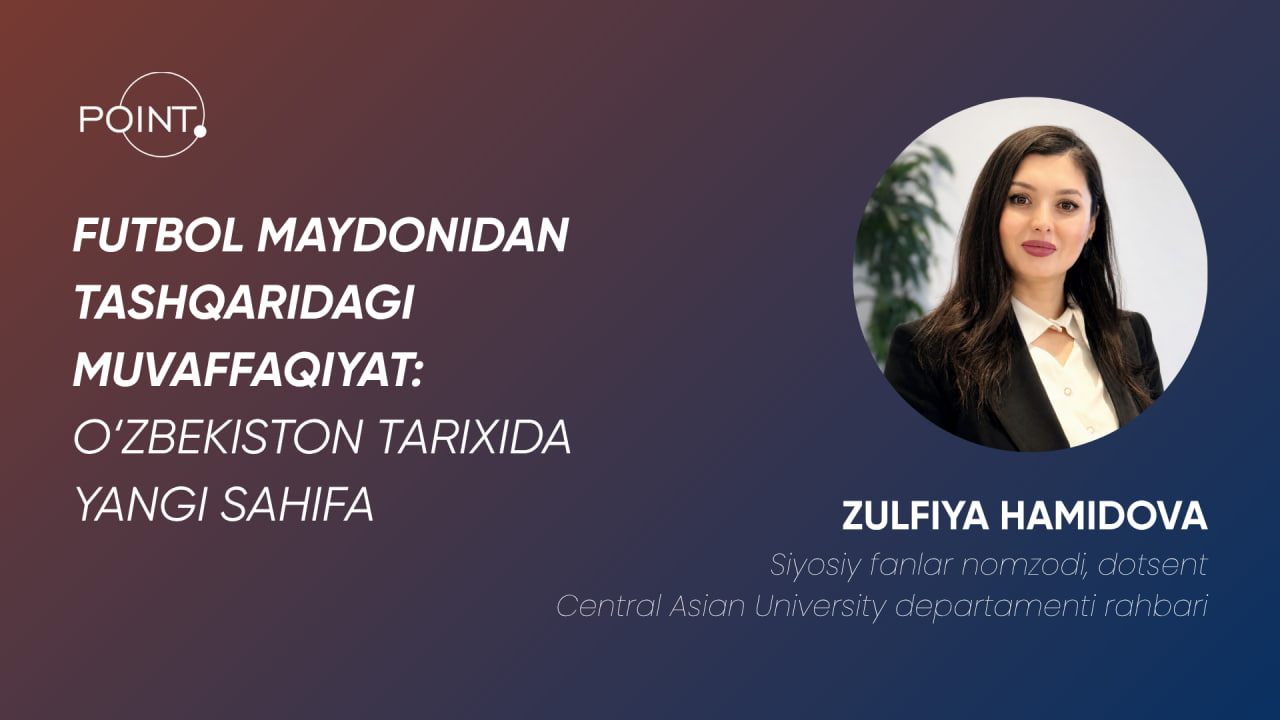
Zulfiya Tolibovna Hamidova
Candidate of Political Sciences, Associate Professor
Head of Department, Central Asian University