

Institutionalizing the Water-Energy Complex in Central Asia: A Driver of Regional Integration and Sustainable Growth
How institutional coordination in water and energy sectors will shape regional stability by 2030?
In Central Asia, water and energy have long ceased to be merely sectoral concepts. Today, they represent the backbone infrastructure of agriculture, industry, budget stability, and the investment climate. Through the water-energy complex (WEC), risks are redistributed among regional states, while at the same time the gap between declarative integration and real economic convergence becomes clearly visible.
By 2030, the central question will be straightforward: can the region manage interdependence as a strategic asset, or will it continue to treat it as a source of seasonal crises?
In reality, the region is not facing absolute resource scarcity. The core challenge lies in spatial and seasonal imbalance. Upstream countries possess significant hydropower potential, while downstream states depend on stable water supply, particularly for irrigation. As a result, water demand peaks in summer when hydropower generation increases, whereas in winter electricity demand rises while water availability becomes constrained. Without systematic coordination, this mismatch leads to excess capacity, increased pressure on thermal power generation, and significantly higher budget expenditures.
Ultimately, the region is forced to pay an additional “cost of misalignment.” In other words, institutional risk is embedded into capital costs, slowing down infrastructure development.
For this reason, institutionalizing the WEC is an important economic instrument aimed at reducing systemic costs. It requires not only political dialogue but also concrete operational mechanisms: transparent rules for cross-border electricity trade, agreed seasonal water-energy exchange schedules, unified calculation methodologies, and modern digital monitoring systems.
From a practical perspective, this means introducing a seasonally balanced system based on pre-agreed compensation mechanisms. Such an approach transforms potential crises into a manageable economic process and significantly reduces the need for ad hoc manual interventions during periods of scarcity.
In recent years, the restoration of parallel operation among Central Asian energy systems has significantly increased flexibility in energy balancing. Expanded intersystem flows have helped smooth seasonal demand peaks and reduce the need for costly reserve capacities. The next step is the creation of a unified digital platform capable of monitoring water and energy flows in near real time. Greater information transparency, in turn, reduces transaction costs in negotiations and strengthens mutual trust.
The link between the WEC and the Sustainable Development Goals is also of practical importance. According to available data, up to 90% of water consumption is attributed to agriculture. Therefore, even a 10–15% increase in irrigation efficiency can save large volumes of water without new hydrotechnical infrastructure. This makes the introduction of unified methodologies for assessing losses and efficiency not merely a technical issue, but a key component of regional stability.
Moreover, the climate agenda further increases the importance of institutional solutions. The Paris Agreement and national climate commitments require greater alignment between water and energy policies. Through institutional coordination, it becomes possible to reduce carbon intensity, enhance resilience to droughts, and attract green financing. In this sense, the WEC is becoming an integral part of the region’s emerging climate architecture.
Uzbekistan plays a particularly important role in this process. Since 2018, Consultative Meetings of Central Asian Heads of State have provided strategic momentum to the water-energy agenda. The country consistently promotes a shift from declarative approaches to practical mechanisms, including the development of regional electricity market elements, expansion of intersystem connectivity, digitalization of water accounting, and modernization of irrigation infrastructure. In particular, the widespread introduction of drip and sprinkler irrigation technologies, reduction of water losses, and implementation of modern monitoring systems contribute not only to national but also to regional sustainability.
Institutionalization of the WEC will also enhance the region’s investment attractiveness. The formation of joint project portfolios in energy system integration and digital water management, particularly with the participation of international financial institutions, helps reduce the cost of capital. For investors, transparent rules mean predictable and manageable risk.
The outlook to 2030 will depend directly on the depth of institutional decisions. An inert scenario preserves fragmented coordination and increases systemic costs. A partial integration scenario reduces some risks but does not eliminate structural vulnerabilities. Full institutionalization, however, implies the introduction of measurable indicators: volumes of cross-border electricity trade, degree of digitalization of hydrological stations, reduction in water losses, and frequency of coordinated seasonal decisions. Measurability transforms strategy into a truly manageable process.
In conclusion, the issue ultimately comes down to the quality of institutions. A region capable of jointly managing water and energy through transparent rules and digital mechanisms will gain a significant advantage: lower capital costs, greater resilience to climate shocks, and expanded opportunities for industrial growth.
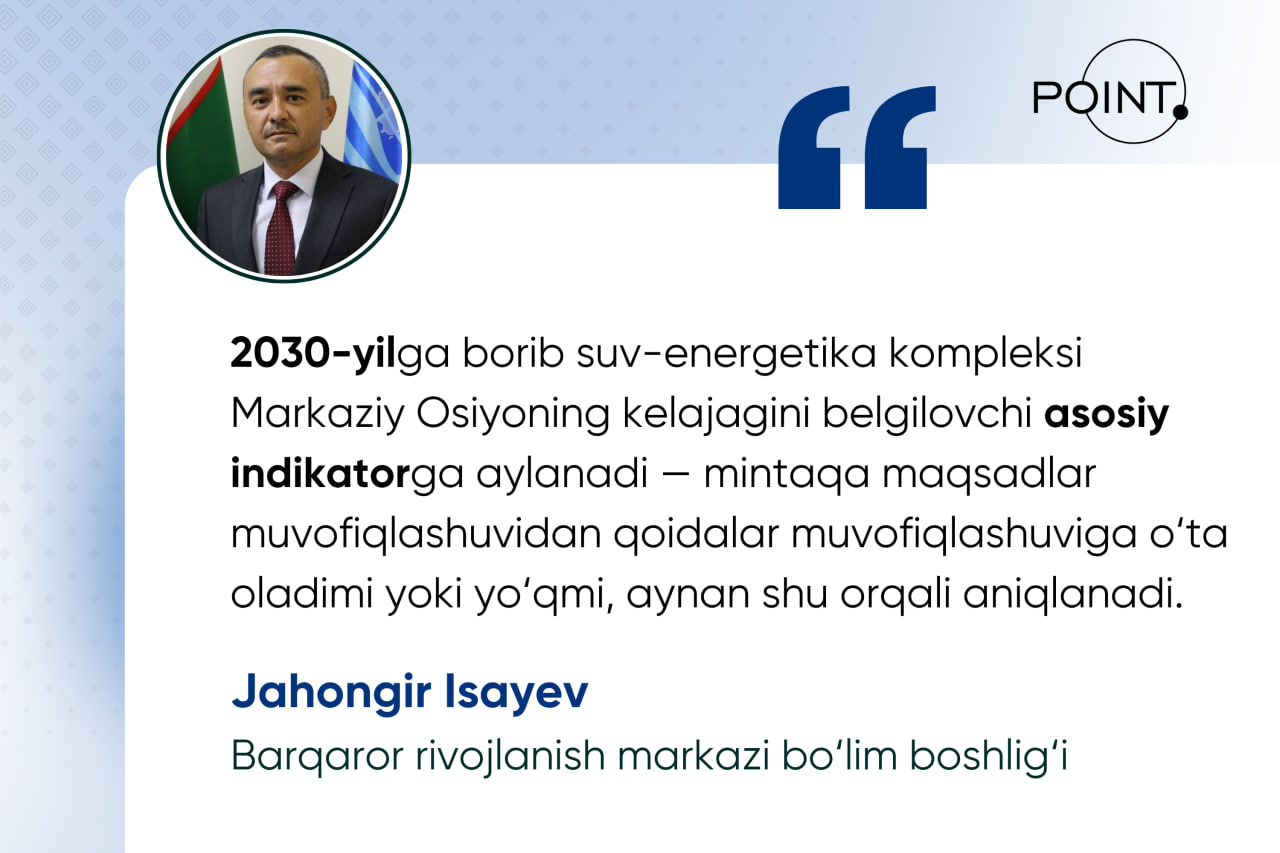
Thus, by 2030, the water-energy complex will become a key indicator for Central Asia—revealing whether the region has truly moved from coordination of intentions to coordination of rules. This is no longer merely a sectoral policy issue, but a question of the region’s strategic development model.
Jahongir Isayev
Head of Division, Center for Sustainable Development