

What Drives Society Forward or Holds It Back: A Social Survey
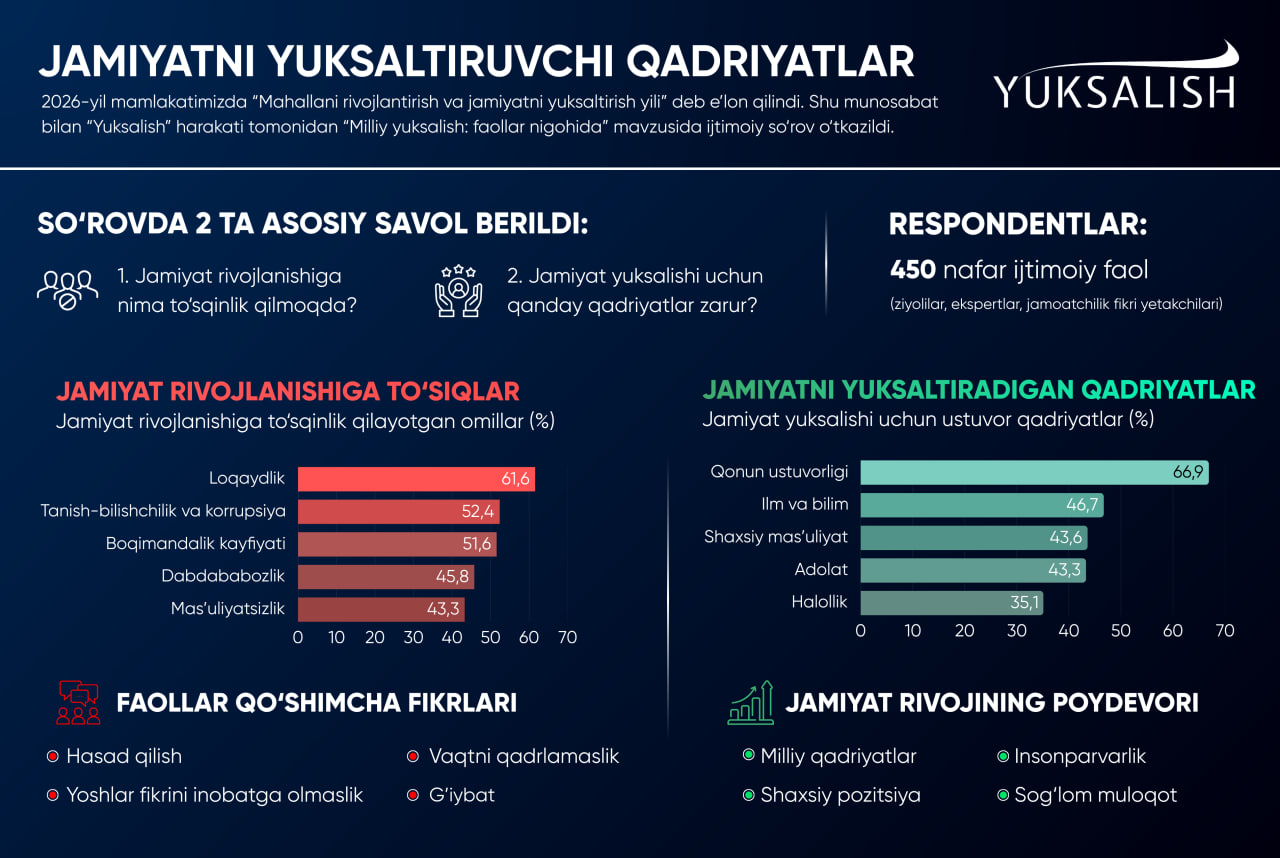
In 2026, our country has declared the year as the “Year of Development of Mahalla (Neighborhood) and Society” To support the reforms outlined in this direction and to study public opinion, the “Yuksalish” movement conducted a social survey titled “National Development: Through the Eyes of Activists.”
The survey involved 450 socially active participants from across the country, including intellectuals, experts, and public opinion leaders. Among them were political scientist Farhod Tolipov, media expert Beruniy Alimov, civil society activist Dilmurod Yusupov, public figure Shahnoza Soatova, and journalist Ilyos Safarov, who shared their views and perspectives.
Within the framework of the survey, respondents were asked two key questions. The first question focused on identifying the factors hindering societal development. In response, participants highlighted indifference, nepotism and corruption, dependency, wastefulness and extravagance, localism, as well as irresponsibility and negligence as major issues. The second question addressed the values necessary for societal progress. Participants emphasized the importance of the rule of law, respect for knowledge and education, personal responsibility, justice, as well as honesty and dignity.
Factors Hindering Development
The results of the first question showed that the biggest obstacle to societal development is indifference. 61.6% of respondents (277 responses) identified a lack of concern for surrounding events and the attitude of “it does not concern me” as the main problem. Nepotism and corruption were also noted as significant issues, with 52.4% (236 responses).
Additionally, 51.6% (232 responses) pointed to a dependency mindset, while 45.8% (206 responses) considered excessive spending and extravagance at weddings and ceremonies as a barrier to development. 43.3% (195 responses) highlighted irresponsibility and negligence as major obstacles to social cohesion.
Factors such as localism, envy and gossip, poor time management, and disregard for youth opinions were mentioned less frequently by respondents.
Key Values for Progress
When asked which values should serve as the foundation for societal development, respondents provided varied answers.
Among them, 66.9% (301 responses) identified the rule of law as the most important factor. Additionally, 46.7% (210 responses) emphasized the importance of science and education as essential conditions for progress, noting that societal development is impossible without skilled professionals and an educated generation.
Personal responsibility (43.6%, 196 responses), justice (43.3%, 195 responses), honesty, and active civic engagement (35.1%, 158 responses) were also recognized as key values.
Additional Reflections from Participants
During the survey, participants also addressed several moral and social issues. They emphasized that family, humanism, and mutual respect are the fundamental pillars of society. The importance of effective time management was also highlighted as a key factor in development.
Activists stressed the need to preserve national traditions while fostering an open and healthy environment for communication within society. Furthermore, honesty, dignity, and the value of peace were recognized as the foundation of moral development.
Conclusion
The analysis shows that social activists expect not only economic reforms in 2026, but also deep moral and legal transformations. In their view, the foundation of progress lies in the rule of law, justice, education, and personal responsibility.
Thus, the study demonstrates that within the “Year of Development of Mahalla (Neighborhood) and Society” economic reforms alone are not sufficient. The main focus should be on transforming human capital—eliminating indifference among citizens and ensuring the rule of law.
In other words, society must transition from indifference to responsibility. This very approach should define the essence and direction of the development programs planned for 2026.
Press Service of the “Yuksalish” Movement