

The Role of Civil Society in the Implementation of the SDGs and the Preparation of the VNR in Kyrgyzstan
In 2015, the Kyrgyz Republic endorsed the resolution adopted by the United Nations General Assembly entitled “Transforming Our World: The 2030 Agenda for Sustainable Development”, which established 17 Sustainable Development Goals (SDGs). The bulk of the work related to the adaptation and development of national indicators was carried out in 2016 and remains ongoing. While Kyrgyzstan’s civil society has actively engaged in this process, institutional mechanisms to ensure sustainable and consistent outcomes have yet to be fully established.
The Sustainable Development Goals have been integrated into national policy and are reflected in the National Development Strategy of the Kyrgyz Republic for 2018–2040, approved by Presidential Decree. As part of this strategy, it was established that “A system for monitoring and evaluating programmes and strategies—both public and professional—will be introduced. Evaluation results must be made publicly accessible and will serve as a basis for stakeholder discussions.” International experience demonstrates that the use of monitoring and evaluation mechanisms provides an effective means to incorporate diverse stakeholder perspectives in the process of achieving the SDGs.
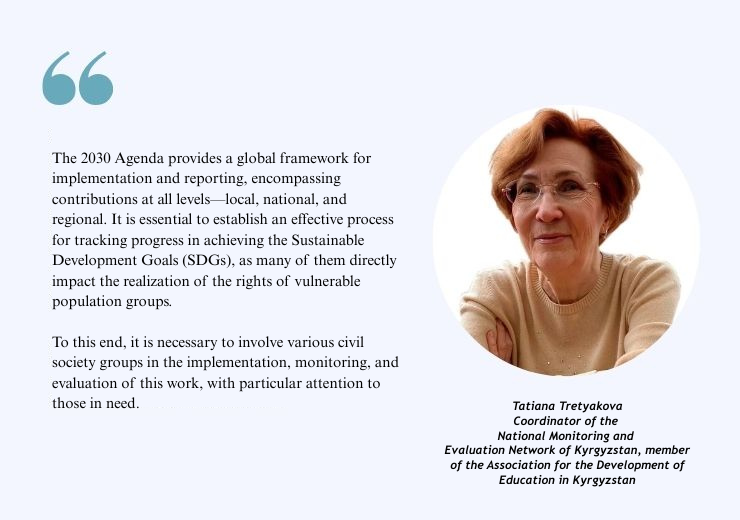
The 2030 Agenda provides for a global framework for implementation and reporting that encompasses contributions at all levels — local, national, and regional. It is essential to establish an effective mechanism for tracking progress toward the SDGs, as many of them directly impact the realization of the rights of vulnerable populations. To this end, it is crucial to involve various civil society groups in the implementation, monitoring, and evaluation of these efforts, with particular attention to marginalized and disadvantaged communities. Special emphasis is placed on fostering collaboration between civil society organizations and government institutions, as sustainable and reliable outcomes can only be achieved through effective partnership and coordinated action.
Kyrgyzstan has prepared two Voluntary National Reviews (VNRs), in 2020 and 2025. A significant positive aspect of the reporting process was the established engagement and structured participation of various civil society groups. During the preparation of the VNRs, broad consultations were conducted involving all segments of civil society, including the private sector, academia, local communities, business organizations and associations, and the media. Notably, the reporting process also included an analysis of the overall landscape of service delivery by civil society organizations at the local level, assessing the effectiveness of state–civil society interaction and impact in the provision of services and the achievement of the SDGs.
Civil society representatives may express diverse perspectives. Importantly, this process creates an opportunity to gather systematic feedback from the beneficiaries of programs and projects implemented in the country. They provide insights into the outcomes achieved, and this feedback is subsequently analyzed and presented in the public domain. Civil society organizations engaged in service delivery contribute data on the challenges they encounter and the difficulties in cooperating with other actors, thereby helping to identify procedural and regulatory barriers that hinder effective collaboration. These discussions also serve as a platform for sharing best practices and successful experiences. Based on such dialogues, it becomes possible to develop recommendations on methodologies and standards for service evaluation, as well as on the parameters for interaction between government bodies and civil society organizations.
During the discussions, differences in the nature of service delivery and operations between civil society organizations and government institutions were identified, including areas of contention and disagreement. Government bodies operate according to defined regulations, standards, and mandated functions, and are responsible for entire sectors, including oversight of civil society organizations. Their activities are supported by stable, ongoing budgetary allocations. In contrast, NGOs typically bear responsibility for specific, often narrowly defined target groups, which may be addressed independently of broader policy frameworks. Moreover, civil society organizations often rely on variable sources of funding; shifts in donor priorities may influence both the focus and accountability of their activities in line with the missions of new funders. An exception to this pattern may be associations affiliated with large-scale business interests.
Given this context, greater effectiveness in achieving the goals can be attained through mutual support, whereby NGOs provide data on the real situation at the local level and share information on the most effective methods and tools, as well as carry out validation, public monitoring, and evaluation. Government institutions, in turn, can benefit from access to localized data that reveal specific factors contributing to the success or failure of certain outcomes. By comparing these findings with data from the National Statistical Committee, which reflect trends and capture results at the macro level, it becomes possible to generate evidence to supplement and revise ongoing policy implementation.
At present, the inclusion of data generated by civil society in tracking progress toward the Sustainable Development Goals (SDGs) is increasingly encouraged. The 2030 Agenda highlights monitoring and evaluation as one of the key instruments for effective implementation. This process should not be limited to the mere measurement of indicator values, but must also ensure continuous analysis of the experience gained and its application for improving practices by all relevant stakeholders. In this context, public monitoring is beginning to play a significant and growing role.
It was also noted that, in analyzing the effectiveness of government program implementation, data must be assessed in relation to the planned policy measures in order to determine the effectiveness of their execution. This requires a clear understanding of the underlying policy objectives, as well as analytical capacity to evaluate the alignment of implementation measures and the accuracy of proposed indicators. When civil society organizations engage in discussions without taking into account current policy measures and objectives, discrepancies in data interpretation may arise. Therefore, it is essential that, in setting the objectives of public monitoring or providing project implementation data, civil society organizations establish constructive relationships with government institutions and present their data in alignment with institutional needs.
Another key focus for enhancing civil society engagement in the implementation of the SDGs is the need to develop methodological and conceptual approaches for interpreting civil society data in a way that is accessible and usable for government institutions. Civil society data are often generated using different methodologies, sampling techniques, and data collection objectives, which significantly complicates direct comparison with official data. As an interim, informal solution during the preparation of the Voluntary National Review, it was agreed that civil society data would be used as “living voices” to illustrate specific challenges or success stories. At the same time, a task was set to develop formal approaches for the integration of civil society data into policy processes. Addressing this challenge also requires equipping public officials with the skills necessary to analyze and reconcile data from multiple levels and sources.
To assess how to enhance the effectiveness of civil society engagement in the implementation of the SDGs, a framework analyzing levels of participation was employed to identify at which levels breakdowns may occur and for what reasons. A common factor contributing to the limited involvement of civil society is the lack of accessible information about opportunities to participate in SDG implementation, particularly within the scope of ministries’ efforts to support vulnerable populations. Consequently, the need to develop effective information dissemination channels was identified, taking into account current realities—such as the growing number of digital media platforms and new content formats that are appealing and accessible to vulnerable groups. Local-level NGOs providing services can play a key role in disseminating this information.
It was also noted that consultations with civil society primarily take place during the preparation of the Voluntary National Reviews (VNRs), and occur only rarely in the periods between. Dialogue and partnership between government institutions and civil society remain largely non-institutionalized, despite the fact that the overall legal framework is conducive to fostering such collaboration. However, the factors outlined above—namely the differing nature and responsibilities of government bodies and civil society organizations, as well as varying standards of reliability and requirements for data—highlight the need for further development and formalization of interaction procedures.
Therefore, in order to establish an effective mechanism of cooperation that yields tangible results, it is essential to overcome the identified gaps and to develop clear objectives, procedures, and regulations governing the interaction between civil society and government institutions. To this end, the development of the 2030 SDG Implementation Roadmap must incorporate measures aimed at addressing existing barriers and enhancing the overall effectiveness of SDG achievement at all levels.
Kyrgyzstan has incorporated the achievement of the Sustainable Development Goals into the National Development Program of the Kyrgyz Republic through 2030 as one of its key priorities. Therefore, special attention must be given to overcoming the identified barriers and to developing and implementing mechanisms for fostering effective cooperation among all national stakeholders.
Tatiana Tretyakova
Coordinator of the National Monitoring and
Evaluation Network of Kyrgyzstan,
Member of the Association for the Development of Education in Kyrgyzstan