

Civil Society and Sustainable Development: the role of NGOs in Uzbekistan in achieving the SDGs and advancing International Partnerships
Amid escalating global challenges — ranging from climate change, biodiversity loss, and environmental instability to social inequality and the digital divide — the concept of sustainable development serves as a systemic framework for rethinking development models and formulating effective strategies at the global, regional, and national levels.
One of the key stakeholders contributing to the implementation of the 2030 Agenda is non-governmental, non-profit organizations (NGOs), which play a strategic role in mobilizing public potential, fostering social cohesion, and introducing innovative solutions. In the Republic of Uzbekistan, against the backdrop of comprehensive reforms and the active expansion of mechanisms for public participation, the role of NGOs and civil society institutions in the localization of the SDGs, the promotion of sustainable initiatives, and the monitoring of progress achieved is steadily increasing and gaining clearer institutional recognition.
Since 2018, Uzbekistan has adapted 16 out of the 17 Sustainable Development Goals (SDGs), integrating them into strategic, regulatory, and programmatic planning at both national and regional levels. In 2023, the country completed the revision of its National SDG Framework, which now includes 206 indicators encompassing social, economic, environmental, and institutional dimensions of sustainable development. A central component of this effort is the Development Strategy “Uzbekistan – 2030”, which outlines national priorities aligned with the global 2030 Sustainable Development Agenda. These priorities include ensuring inclusive and quality education, reducing all forms of poverty, securing access to affordable and clean energy, advancing climate adaptation, promoting digital transformation, and enhancing citizen participation in decision-making at all levels.
To coordinate and monitor the implementation of the SDGs in the Republic of Uzbekistan, an Interagency Coordinating Council under the Cabinet of Ministers has been established, and a system for the preparation of Voluntary National Reviews has been introduced.
As of May 2025, more than 12,000 non-governmental non-profit organizations (NGOs) are registered in Uzbekistan, of which approximately 2,450 are actively engaged in initiatives aimed at achieving the Sustainable Development Goals. Their activities have broad geographical coverage, encompassing all regions of the country, including hard-to-reach and remote rural and mountainous areas.
The thematic diversity of projects implemented by NGOs reflects the multidimensional nature of sustainable development and encompasses priority areas such as comprehensive environmental protection initiatives (SDGs 13, 15); inclusive and equitable education (SDG 4); the promotion of gender equality (SDG 5); and social protection for vulnerable population groups (SDGs 1, 10).
Particular emphasis should be placed on the pivotal role of NGOs and think tanks, which are becoming an integral part of the global environmental agenda. Their participation in international forums contributes to the generation of new ideas, in-depth analysis of emerging trends, and the development of practical recommendations for governments and international organizations.
In this context, particular attention should be given to the activities of the NGO Center for Sustainable Development, established in 2021, which is actively engaged in scientific analysis, monitoring of environmental and climate processes, and the development of strategic initiatives in the field of “green” growth. The Center serves as a vital link between the academic community, government authorities, and international institutions, making a significant contribution to shaping effective environmental policy and advancing the national sustainable development agenda at the global level.
It is the integration of academic and applied knowledge with practical policymaking—particularly through the work of institutions such as the Center for Sustainable Development of Uzbekistan—that provides a solid foundation for developing effective solutions in the face of climate challenges and the global transformation of the economy.
The Environmental NGO Forum—established in September 2004 at a conference of leaders from 48 NGOs and grassroots initiatives—coordinates expert-driven initiatives in the areas of biodiversity conservation, climate resilience, environmental education, and citizen participation in the development of environmental policy. It organizes public consultations, training workshops, and environmental protection campaigns.
The Eco-Resource Center “Ecomaktab” initially operated as a grassroots initiative since 1999 and was officially registered as a non-governmental organization in 2005.
The organization’s mission is to unite the creative and intellectual potential of students, educators, journalists, and leading scholars to advance environmental education and foster a culture of ecological awareness among the population. It aims to raise public awareness in the fields of environmental protection, biodiversity conservation, local heritage studies, and active forms of nature-based tourism. An integral part of the organization’s work is supporting the development of small and family businesses based on the rational use of resources and responsible environmental practices. The organization also implements initiatives to promote and develop eco-tourism in Uzbekistan.
The non-governmental, non-profit organization Tech4Impact, established in 2019, operates in the fields of innovation development, information technology, startups, human capital, green technologies, and youth and women’s entrepreneurship in Uzbekistan and the Central Asian region.
Tech4Impact’s programs target a diverse audience—ranging from girls aged 10 to 18 and families with children to youth, entrepreneurs, startup founders, and professionals in the fields of science and technology.
The activities of NGOs in Uzbekistan are of strategic importance and represent a vital component of the national sustainable development agenda. Their projects contribute to:
— Enhancing public engagement in reform processes through education, consultation, and participation;
— Expanding access to innovative and green technologies at the community level;
— Developing human capital, particularly among youth and women;
— Fostering a culture of sustainable consumption and environmental responsibility;
— Supporting reforms in key sectors, including the environment, economy, education, and digital transformation.
Thus, NGOs act not only as implementers of individual initiatives but also as full-fledged partners of the state and international institutions in building a sustainable and inclusive future for Uzbekistan.
Over the past three years, the NGO sector in Uzbekistan has demonstrated a shift toward sustainable institutional development.
According to the 2024 report of the National Association of NGOs, the share of organizations participating in international projects increased from 17% in 2020 to 31% in 2024, with a steady upward trend. Over 60% of NGOs in Uzbekistan sustain their operations through government support, grants from international agencies (including UNDP, KOICA, the EU, and others), and multilateral programs. The remaining organizations operate through membership fees, local donations, social entrepreneurship, and corporate partnerships.
In 2023–2024 alone, more than 550 projects aimed at achieving the Sustainable Development Goals were implemented within the framework of national, regional, and cross-border initiatives.
Among them are programs focused on digital inclusion and education, sustainable land use, environmental protection, poverty reduction, social protection, inclusive education, and the promotion of human rights. Reports indicate an improvement in project effectiveness and management quality, which has strengthened the confidence of international donors in Uzbekistan’s NGOs.
Uzbek NGOs are actively expanding their participation in international partnerships, as evidenced by their integration into transnational networks, exchange of best practices, and joint implementation of programs aimed at achieving global and regional SDGs. Through active engagement in international forums, the signing of cooperation memorandums, and the implementation of joint research and practical initiatives, Uzbek NGOs are strengthening their institutional resilience, broadening the thematic scope of their activities, and enhancing their expertise and project management capacity.
In 2025, a delegation from Uzbekistan participated in the UN Regional Forum on Sustainable Development in Geneva, where examples of SDG localization, practices of public monitoring, and mechanisms for the inclusion of vulnerable groups were presented. At these forums, NGO representatives showcased their work in areas such as digital transformation, women’s leadership, climate adaptation, and multi-level partnerships. Such participation contributes not only to international recognition but also to resource mobilization, the exchange of innovations, and the increased visibility of Uzbekistan’s NGOs on the global stage.
In recent years, Uzbekistan has made significant progress in strengthening the role of civil society and expanding the participation of non-governmental non-profit organizations (NGOs) in the implementation of key sustainable development priorities. Institutional reforms, improvements in the legal and regulatory framework, and a growing openness to dialogue have laid a solid foundation for the continued development of the sector.
At the same time, as Uzbekistan's international commitments continue to grow, new challenges and opportunities are emerging for civil society, particularly in the sphere of international cooperation. The active involvement of NGOs in cross-border initiatives, participation in global projects, and engagement in international dialogue platforms still requires additional efforts.
Many organizations demonstrate strong potential, yet at the same time seek to further strengthen their project management capacities, familiarize themselves with international standards, and expand their partnership networks. In these areas, there is considerable interest within the civil society sector in training programs, knowledge exchange, and support from international partners.
Thus, the current stage of development can be characterized as a transition from the phase of institutional formation to a stage of active integration into the international sustainable development arena, where strengthening mutual trust, joint planning, and the development of mechanisms for coordinated participation in the SDGs play a central role.
In order to leverage the positive experience and potential of international partners, it is advisable to consider the following proposals for the further development and international integration of NGOs:
- Support NGO efforts to expand international cooperation through the development of grant instruments, provision of advisory assistance, and facilitation of participation in global initiatives, forums, and projects.
- Establish a national digital platform for interaction between NGOs and international partners, which would include:
- an open registry of active NGOs and their projects,
- information on international competitions and fellowship opportunities,
- tools for partner search and knowledge exchange.
Спросить ChatGPT.
- Initiate a dialogue on the establishment of a Resource Center for International NGO Partnership, whose objectives would include:
- conducting training sessions on international project management;
- developing reporting skills in line with international standards;
- promoting best practices in sustainable development.
- Encourage the establishment of thematic networks and NGO consortia focused on the joint implementation of projects in the areas of sustainable development, inclusive education, environmental protection, and digital transformation.
- Continue efforts to improve regulatory mechanisms that ensure favorable conditions for international cooperation, including transparent procedures for grant registration and the development of public oversight mechanisms.
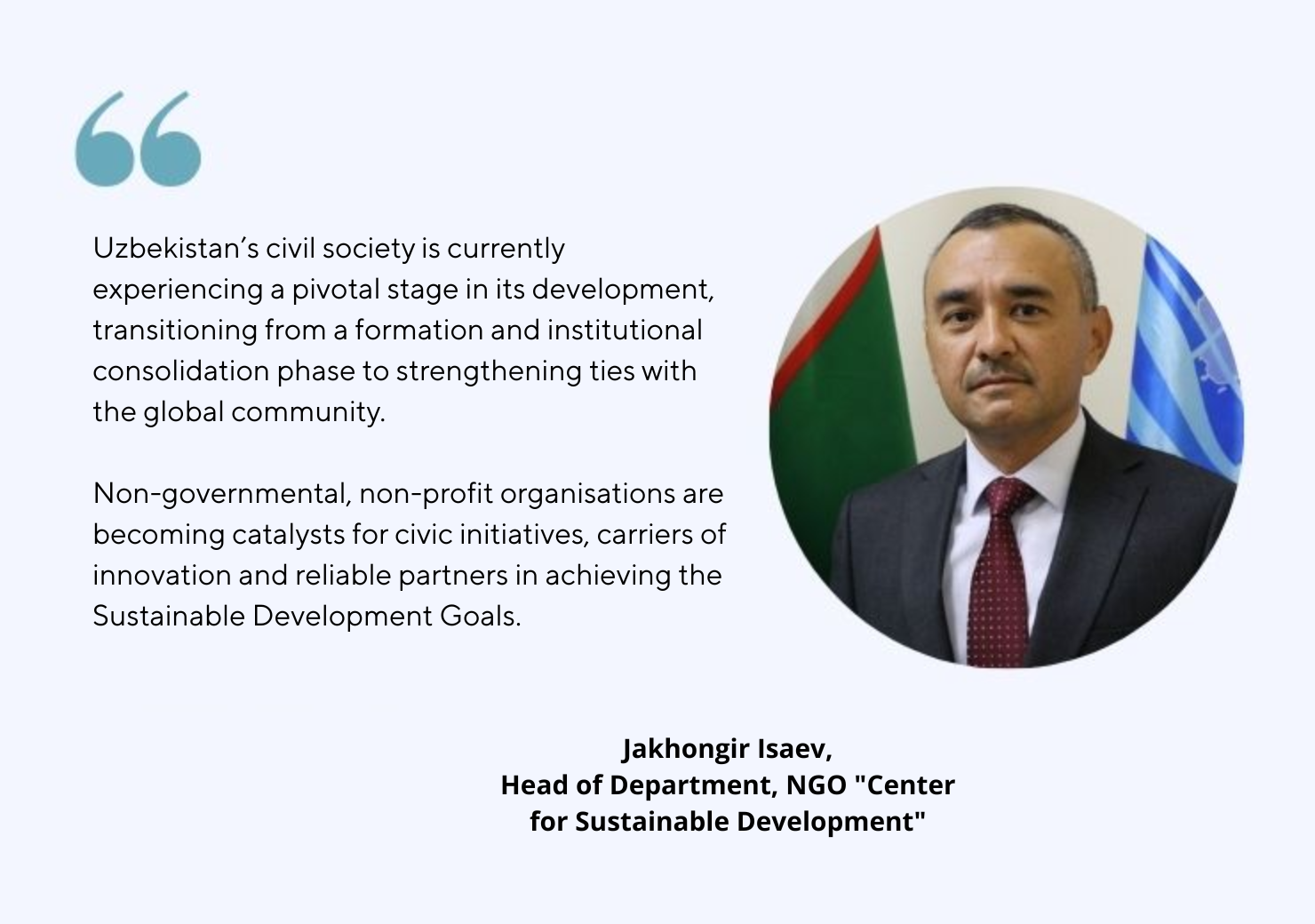
Uzbekistan’s civil society is currently undergoing a critical stage in its development—transitioning from the phase of formation and institutional consolidation to the strengthening of ties with the global community. Non-governmental non-profit organizations, in particular, are emerging as catalysts for civic initiatives, drivers of innovation, and reliable partners in achieving the Sustainable Development Goals.
In this regard, strengthening strategic partnerships between government institutions, NGOs, and international organizations appears particularly relevant, with the aim of advancing joint initiatives, enhancing project capacities, and expanding horizontal linkages.
Uzbekistan is genuinely committed to building a sustainable and inclusive society in which civic engagement plays a central role. It is through cooperation, mutual learning, and openness that the path toward a truly sustainable future—at the national, regional, and global levels—can be forged.
Jakhongir Isaev,
Head of Department, NGO “Center for Sustainable Development”