

Corruption Risks Surveys in Admission to Primary School Covered Nearly 5,000 Respondents from 114 Schools in Uzbekistan

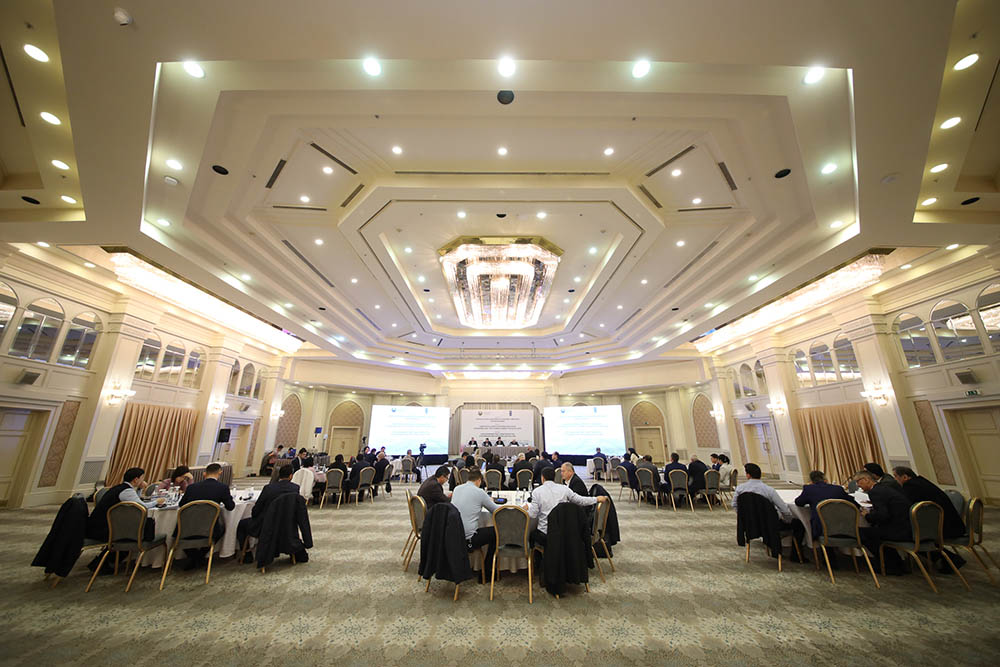
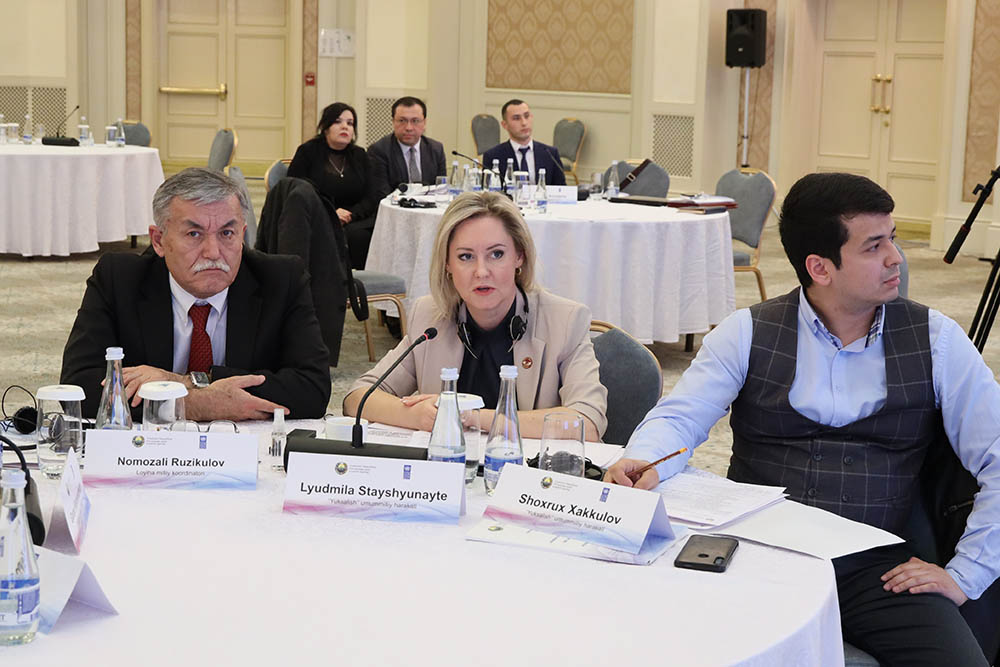
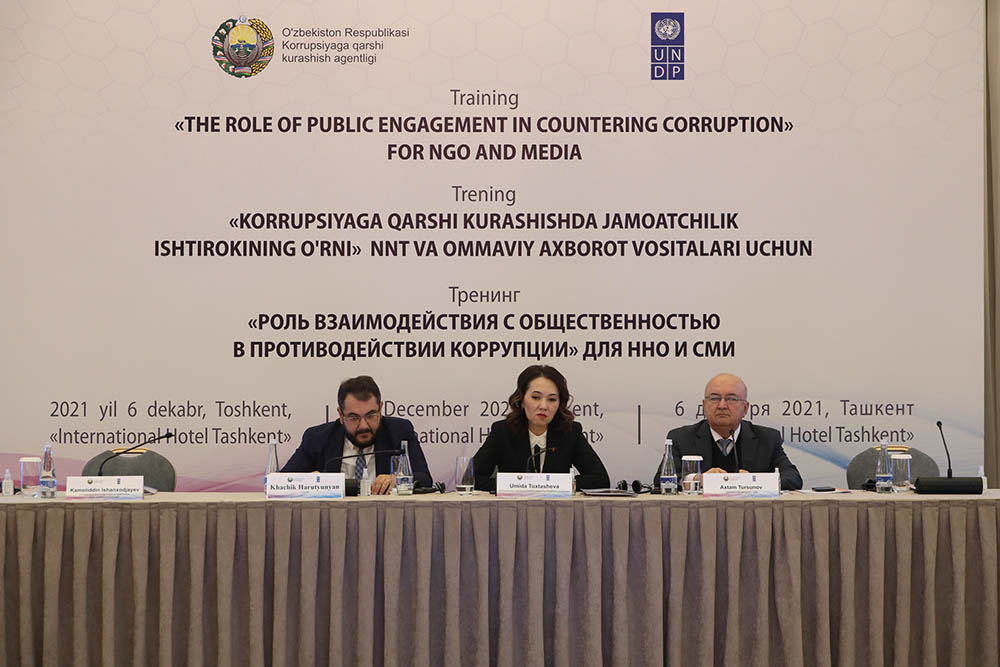
At an NGO and mass media event within the framework of the Anti-Corruption Week, the Nationwide Movement ‘Yuksalish’ presented the key results of the first stage of the project ‘Establishing the First Anti-Corruption Laboratories in Uzbekistan’. The project is being implemented by the NWM ‘Yuksalish’ in partnership with the international NGO Regional Dialogue (Slovenia) and the Anti-Corruption Agency of Uzbekistan.
The project goal is to establish expert laboratories, conduct research and corruption risks assessment in education throughout the country, engaging the public. The first stage of the project, including questionnaire surveys and interviews, focused on identifying and assessing factors of corruption risks in admission to primary school.
The study covered 4,920 people, including 114 school principals, 1,563 primary school teachers and 3,243 parents of first-graders in 114 schools in 14 regions of Uzbekistan. In April, pilot surveys were conducted among three groups of respondents in two schools in Tashkent. In May-June, large-scale surveys were held in 114 schools in 14 regions of Uzbekistan, covering 28 cities, 31 regional centers, 31 rural settlements.
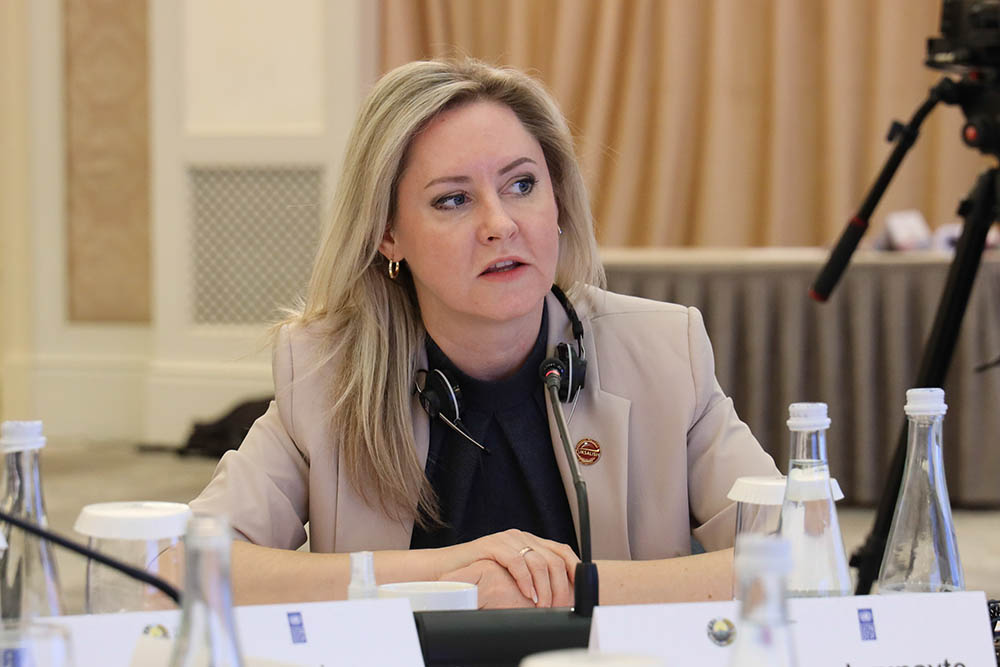
“The research helped to assess the factors and risks that lead to corruption or unethical behavior in admission to school,” says Lyudmila Stayshyunayte, Project Manager of the Anti-Corruption Laboratory. “The surveys allowed respondents voicing problems in the education system in all regions of the country, and making proposals for their elimination. Advanced global experience shows that the use of modern technologies, the widespread introduction of open data can significantly expand transparency of processes, and as a result, minimize a significant number of corruption risk factors.”
The experts named the key recommendations based on the results of the research:
- Creation of a unified open data platform covering all institutions of the public and preschool education sector, with the possibility of online admission to the first grades of schools without the need for parents to visit schools.
- Legalization of parental financial aid, ensuring the full participation of school administration and parents in planning and spending financial resources of schools.
- Mandatory coordination with the public and strengthening of public oversight over the transparency of planning and placement of building designs for future schools, provision of a sufficient number of student places, over the allocation and use of budgetary funds.
- Implementation of a comprehensive integrity system, including the practical application of the values and norms of professional integrity, fixed in the relevant rules and procedures (Code of Ethics, best practices for ethical employment).
- Organization of work with parents on a fundamentally new platform for a better understanding of their role, the rules of ethics of the educational process, integrity of school staff and elimination of parental distrust of the system.
- Introduction of a notification system in cases of dishonest or unethical behavior for all participants in the process (within the Ministry of Public Education, its departments and schools) and a system of sanctions in order to correct, or prevent such behavior.
“Based on the results of the research, five main areas and factors of corruption risks have been identified, and they are closely interconnected”, notes Lyudmila Stayshyunayte. “The lack of transparency in the admission to primary school leads to the introduction of additional quotas, and to overcrowded classes in the future. Parents and principals get an opportunity of integrity breaches (including gifts, material values, pressure from outside). The lack of budget funding for schools is pushing the administration of an educational institution to seek for additional sources of funding, thereby, creating a ground of influence and exchange of services between parents / teachers / principals. This becomes the cause of integrity breaches and corruptive behavior.”
Low salaries of school employees also lead to the search for alternative sources of income - tutoring, favoritism, exchange of services with parents. As a result, integrity breaches are entrenched as a normal practice. The underdeveloped infrastructure due to the possibility of misusing budget funds and thefts at different levels, as well as the influence and pressure of the school principal on teachers and parents, pressure on the administration from outside by parents and higher authorities are factors of corruption risks.
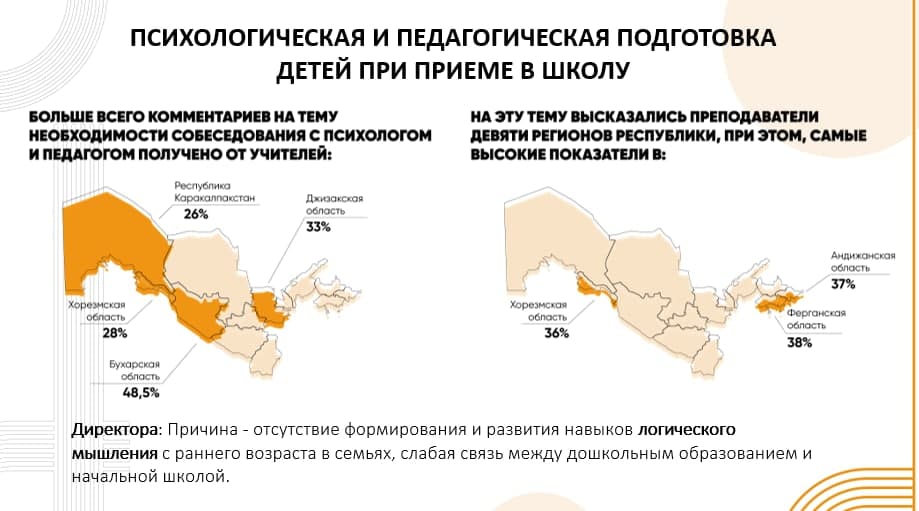
Problems with the psychological maturity of students are a separate challenge. The respondents from among the teachers and principals point out to the insufficient preparedness of children for school. This is due to the fact, that there is a weak connection between preschool and primary education: the nursery school does not always provide proper teaching, and not all parents send their children to nursery school. As a result, children come to school with different level of preparedness. Some parents try to get their child to school early (under seven years of age).
The lack of long-term forecasting, planning of school construction leads to underfunding of schools with a lack of basic technical and sanitary conditions, insufficient provision of textbooks and teaching materials, overcrowding of classes, overloading of teachers and school administration, and that all results in decreasing quality of education in general.
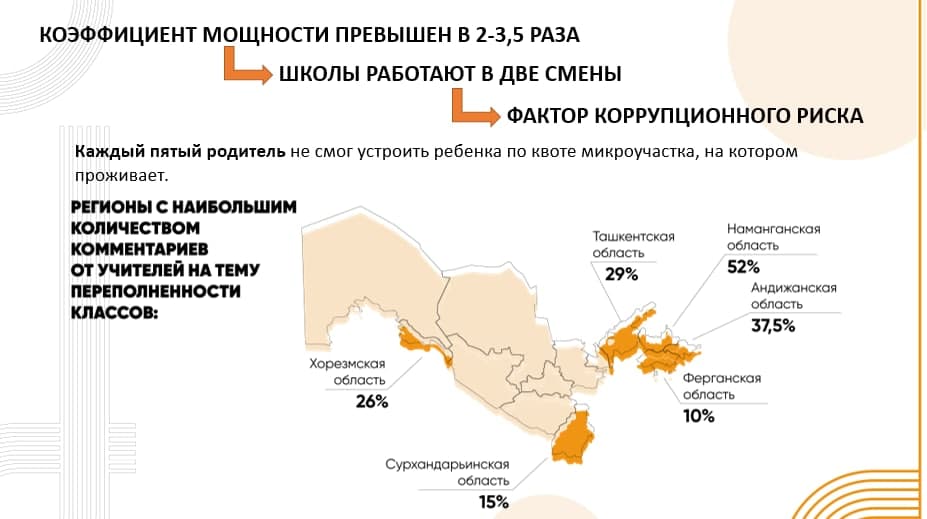
Despite the fact that the Ministry of Public Education is introducing the qabul.maktab.uz online queue system, the results of the research showed the dissatisfaction of the respondents. An analysis of the answers of all three categories of respondents, ranging by territories, showed a shortage of student places, due to the fact that the calculation of quotas and places according to quotas does not take into account the capacity and infrastructure of classrooms, schools and the demographic aspect. Infrastructure issues for educational institutions rank second among teachers' comments after salaries.
An analysis of the perception of professional integrity of school staff and the ethical behavior of parents in admission to school showed the need to raise parents' awareness of the procedures for submitting documents to school and their responsibility for the academic performance of their children.
To the question, how is it possible to influence a teacher's positive attitude towards a child, more than half of the parents surveyed (57%) answered “taking an active part in the life of the class and the school”. About 12% of percent believe that a parent can influence a teacher/principal through influential friends / relatives, and the same number can influence by money or official position.
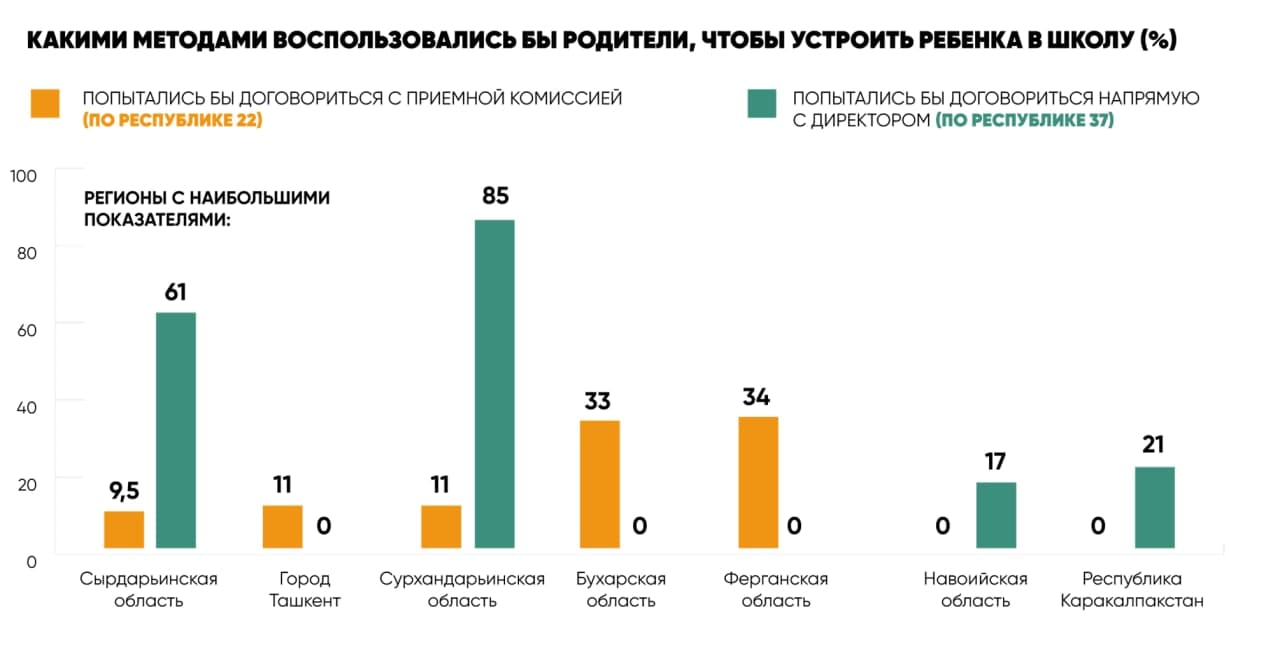
Some parents (2.6%) commented in favor of eliminating the possibility of unofficial pressure on teachers and school principals by public education departments and persons holding high official positions; 1.5% of parents believe that there is a need to stop integrity breaches at the highest levels of government. About 5% recommend introducing the rules of ethical behavior for teachers and school administration to ensure the use of sanctions for violation of the rules of conduct. Among the comments, there is as follows: "There is a privileged attitude of teachers towards children: someone supports the school financially, someone studies well."
“It is important to understand that the unethical behavior of adults, including parents, can be ingrained in children's memory from an early age. For example, giving a gift to a teacher for a good mark, or influencing a principal to shift to a better class can be considered as normal practice for children,” says Lyudmila Stayshyunayte.
“It makes it much more difficult to prevent integrity breaches and corruption risks now, and in the future, and it also lowers the status of the teacher. Such research helps government decision-makers to express public opinion in a real way, providing a realistic picture of the situation on the ground. The developed mechanisms and methodology can be used to assess corruption risks in other areas as well.”
Press Service of the Nationwide Movement “Yuksalish”