

The COVID-19 pandemic: socio-economic situation and stability
The COVID-19 pandemic has become a unique moment of truth for the whole world. It allows to assess how much the health care system, the government and the society are ready to get adapted to force majeure circumstances in short-terms.
The introduction of restrictive measures, on the one hand, helps to prevent the massive spread of infection, and on the other hand, sets the task of prompt response to emerging challenges.
Psychologists state that, as a result of usual people’s lifestyle disorder, the level of their anxiety increases, the number of domestic violence rises, aggression and a tendency to panic behavior is higher. In number of countries around the world, people who are dissatisfied with restrictive measures related to the spread of the coronavirus and concerned about the economic consequences of quarantine, join the demonstrations demanding the abolition of the isolation policies. However, often peaceful protests turn into chaos, accompanied by violence, robbery and looting. For example, the outbreak of violence in Baltimore led to disastrous results: police cars, houses, pharmacies and other buildings were burned, many shops were looted.
The history shows that conflicts and disturbances do not support the establishment a familiar normality and increase the well-being of the population, but rather damage the property and pose a threat to human life and health.
In Uzbekistan, over the past few years, the dialogue with the people has been advancing at all levels of the government. The pandemic today has a diverse impact on society, tending to unite and dissociate at the same time. In this situation, it is important to maintain self-control, be able to think critically and choose a constructive dialogue instead of aggression.
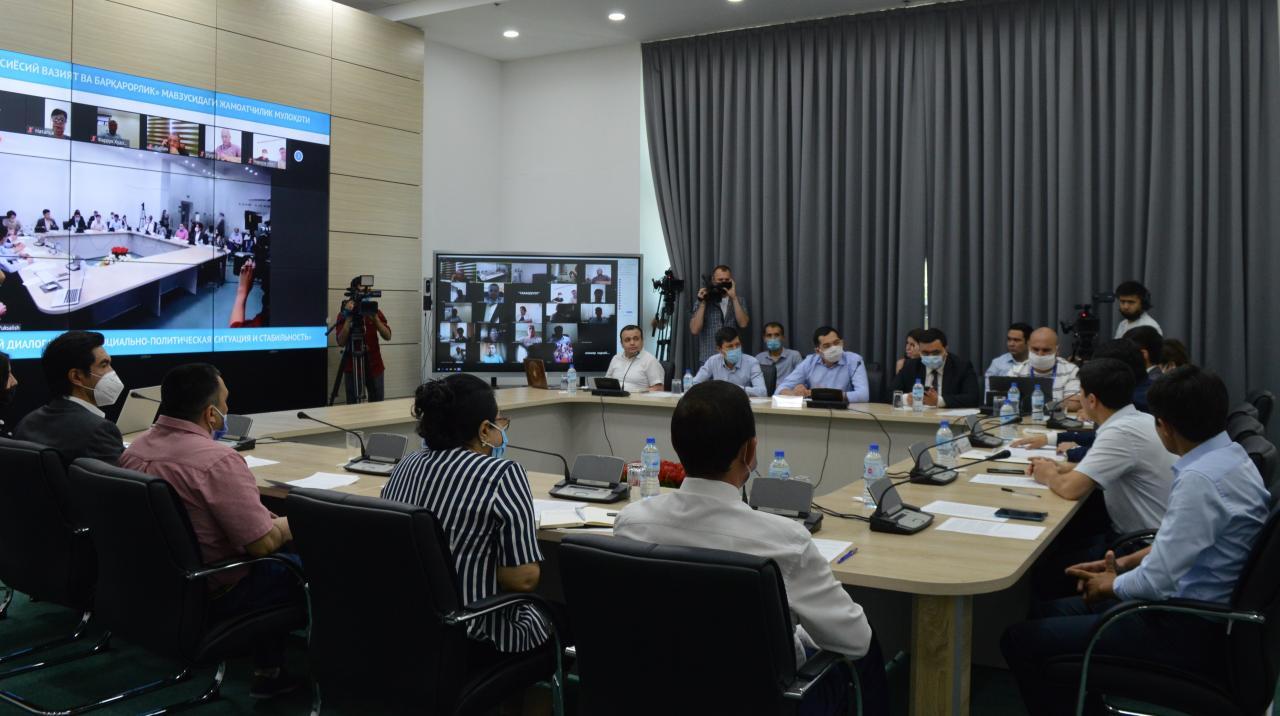
These issues are on the agenda of the state bodies, the parliament of Uzbekistan, and also cause public concern. That is why a number of active citizens, representatives of the civil society, and various communities, together with the Nationwide Movement "Yuksalish" initiated a dialogue on the topic of "Socio-political situation and stability".
The public discussion of the epidemiological and socio-political situation in the world and Uzbekistan took place on June 12 at the office of the Nationwide Movement "Yuksalish", and was attended by activists and leaders of NGOs, think tanks, entrepreneurs, lawyers and legal scholars, journalists and bloggers.
During the event, several areas were covered by the discussion. In particular, the socio-political processes in several Western countries, the psychological aspects of lifestyle during the confinement, the influence of mass crowds on the level of stress on the health care system, and the economic consequences of the pandemic. In addition, the political consequences of the riots, the legal regulation of peaceful demonstrations were examined.
Based on the results of the public dialogue, the participants developed recommendations and proposals to mitigate the socio-political and socio-economic consequences of the pandemic, and respond to emerging challenges. In particular, it was noted that in this situation it is important to increase the effective dialogue of the population with the government, to actively use the capabilities of social networks. In the opinion of experts, timely response to the needs and requirements of the residents of the country, the solution of socio-economic problems on the ground will prevent the escalation of the situation in society. It was emphasized that mass riots are not a solution to the problem; rather, on the contrary, they could delay the development of the state and society for many years. In the context of mass informatization, the development of skills among the population, especially young people, critical thinking, fact-checking, media literacy is of key importance.
Press Service of the Nationwide Movement "Yuksalish"